Squirrels to the Cuts
Reconstructing the Imaginary

In the opening scene of Richard Linklater’s Slacker (1990), a loquacious drifter, played by the director, rambles at his taxi driver from the backseat of their, for the moment, shared vehicle. “Every thought you have creates its own reality,” he tells the stoic chauffeur, before launching into some of the dime store philosophy that Linklater has made his stock and trade in most of the low- or no-budget affairs that have peppered his filmography since. I have never found Linklater’s pseudo-heady discursive excursions particularly moving or profound. But when it comes to the precarious states of limbo affixed and ascribed to the sundry original releases, work prints, reconstructions and restorations that comprise the production and release history of so many films, complicating any notion of the “original” or “real,” he might actually be on to something. Just as every thought creates its own reality (a la Linklater), any concept of core reality falters under the weight of so many successive box-office and home-video releases, revisions and director’s or editor’s cuts. With each successive iteration of a given work, reality evolves and in the doing becomes less distinct.
Film has always been a collaborative art; a collaboration between the haves and the have nots. I am not referring to the typical dichotomy of service providers separated by a caste system based on their placement above or below the proverbial line and the effect it has on their wage and credit on a film’s production, but the relationship between the director – considered in some circles (if they are any good at what they do) the auteur – and the money men at the production and distribution offices, for whom the only line is the bottom one. Tales of films shortened, extended, rearranged, censored or otherwise tinkered with against their creators’ wishes are as old as time, or at least as old as 110 years ago when artisans and money men alike realized there was a fortune to be made in motion picture production and audience captivation by way of revolutionary new visual (soon to become audiovisual) technology. With some films, each new thought and action indeed becomes a new reality, a new cut that may or may not be released, let alone, after some time, still exist.
Film archivists are obviously in agreement that existing films should be catalogued and preserved and rare, lost or damaged ones restored for the sake of a continued understanding of film and cultural history; what they constantly debate is how and sometimes even why. When seeking to restore or reconstruct an “original” with myriad cuts, edits and versions in existence, some, as is the case with many silent films, re-cut separately for American and foreign audiences but exhibited contemporaneously, which of them is truly original? Moreover, as viewing apparati change, is restoration of the original experience necessary, for purposes of posterity, and is it even possible? (Paolo Cherchi Usai, in characteristically polemical fashion, writes, “The notion of an ‘authentic’ restoration is a cultural oxymoron.”) This is all assuming an original is intact, attainable or even detailed enough to recreate. When attempting to fill in gaps, excised for whatever reason, as was the case with Erich Von Stroheim’s Greed (1924), Orson Welles’ Touch of Evil (1958) and Samuel Fuller’s The Big Red One (1980), how does one ethically and tastefully accomplish the task? Further complicating these complications, what do we do with studio- or distributor-compromised texts, the original of which is definitively not what the filmmakers intended?
It is this final question that I hope to address here. Contrary to the archivist’s usual task of preserving or restoring an original text, many belatedly discovered or released work prints and director’s cuts are refutations of that original, instead reconstructions of an original idea or concept. I call these reconstructions of the imaginary pre-original preconstructions. Every film ostensibly exists in multiple forms, but usually just one of them is released to the general public, giving the appearance – the illusion – of completeness. In allowing the audience to see the different iterations, these preconstructions call attention to their respective text’s (and perhaps any result of mainstream filmmaking processes) inherent incompleteness. What else is a work of art that exists in multiple discrete “finished” forms but incomplete? (The alternative would be the oxymoronic phrase “doubly-” or “triply-complete.”)
Since the birth of Hollywood, there is a long history of films maudit (literally, cursed or damned films), productions doomed, for the artists behind them, to end in truncation, redaction and erasure, stifled and hobbled, taken apart and put back together like some unholy Frankenstein monster or otherwise remixed beyond recognition. D.W. Griffith was allowed to release his near-four-hour ode to klan and country, The Birth of a Nation fka The Clansman, raw and uncut in 1915, but Erich von Stroheim’s artier, equally groundbreaking social-realism-cum-tragedy epic was verboten, bordering on kaputt, when he found his nine-hour cut of Greed greedily hacked down to two-and-a-half-hours, for no other reason than you can make more money off a shorter film than a long one. In the end, it could not even do that, quickly and quietly vanishing from theaters, a box-office ($274,827 against $665,603) and creative failure from which Von Stroheim arguably never recovered.
In 1999, after some three-quarters-of-a-century of increased notoriety and estimation of cultural import, Turner Entertainment marshaled its archivists and historians to salvage whatever they could of Von Stroheim’s opus. The result was a four-hour film, with missing scenes explained or represented by intertitles and, whenever possible, single frame stills or production photos. Such is the nature of film restoration and reconstruction, as it has traditionally been conceived and applied, usually to describe the process of recreating silent film texts as they were originally seen when common practice dictated that flammable nitrate reels were to be dumped due to the potential hazard of even keeping them around and celluloid prints decomposed on their own without the proper care. Unsuccessful films were trashed to make space for better performing ones and numerous other films were destroyed just because they were designed to be disposable flavors of the week and certainly never expected to withstand the test of time. (Studies by Deutsche Kinemathek and the Library of Congress, from 2008 and 2013 respectively, estimate that between 75 and 90% of silent films are now lost forever, though Anthony Slide alleges that these statistics are spurious approximations.)
Restorations and reconstructions of obviously damaged films aside, there is a fraught history of films with multiple released cuts, each amending or refuting the last. Jonathan Rosenbaum, the recently retired lead film critic for the Chicago Reader and author of Discovering Orson Welles (2007), has written no less than five articles about the use and abuse of the term “director’s cut” as it has traditionally and often fallaciously been applied to all kinds of re-releases, each purporting to be a closer approximation of the “original” (as conception, if not release) than the last. As Rosenbaum writes, “The basic mythology appears to be that every film has two versions, a correct one and an incorrect one. But in fact this isn’t quite true. A better paraphrase of the mythology would be, more paradoxically, that every film has at least two versions – a correct one and a more correct one, to be succeeded in turn by further upgrades.” Rosenbaum knows this better than most, as he was a consultant on the 1998 re-editing of Touch of Evil based on Welles’ extensive notes to Universal. When that new version was released theatrically and then on DVD, it was advertised as “restored” and “definitive,” despite Rosenbaum’s protestations that “no edition of any film that Welles never completed could meaningfully be called complete.” Historian Vinzenz Hediger voices a similar sentiment about this commodification of cuts, arguing that Turner Classic Movies’ advertising slogan, “It’s what film was and can never be again,” is an example of “the rhetoric of the original” (italicization his), which “systematically suggests that the original is always already lost, the better to legitimize the need for reconstruction.”
Blade Runner (1982), for example, exists in nine different versions, the latest of which, marketed as “The Final Cut” (2007), is a revision of not just the original theatrical version but “The Director’s Cut” (1992) which was an erroneously described re-editing mistakenly approved by director Ridley Scott, who was apparently too distracted by the production of 1492 (1992) to notice. (The exhausting saga of Blade Runner’s many cuts, repeatedly described by Rosenbaum across his many articles as “slapstick,” is the basis of Paul Sammon’s Future Noir: The Making of Blade Runner, initially published in 1996 and updated in 2017.) Francis Ford Coppola and Peter Bogdanovich are (in the latter’s case, were) similarly obsessed with recutting and re-releasing their films, in the former’s case tinkering with them more than 40 years after their initial release. Beginning with his first flop, Daisy Miller (1974), Bogdanovich often maintained that each of his films was better before studio interference, alluding to director’s cuts that occasionally appeared, and were often constructed, years later. [At Long Last Love (1975) was re-released with additional footage in 2013, Nickelodeon (1976) in 2009 and Texasville (1990) in 2023.] Attempting to self-distribute They All Laughed (1981), a sprawling and bizarre screwball comedy featuring an ensemble cast including Audrey Hepburn, Ben Gazzarra, John Ritter and Bogdanovich’s then-paramour, Dorothy Stratten, the 1980 Playboy Playmate of the Year who was murdered that same year by her estranged husband, the director “spent himself into bankruptcy” and arguably into “movie jail.”
In the case of Bogdanovich’s final film, She’s Funny That Way (2014), his provocation proves correct. Recently restored to its original form, almost half an hour-longer, sans awkward framing device and Quentin Tarantino-cameo-featuring ending, the rechristened Squirrels to the Nuts (2020/2025) is a better film in every way. The story of its rediscovery is as exciting as the finished product: In 2020, writer, sometimes-lecturer at City University of New York and longtime Bogdanovich superfan (he describes They All Laughed as his favorite film of all time) James Kenney found an Ebay listing labeled “She’s Funny That Way a/k/a Squirrels to the Nuts Production SONY HDCAM Tape/ Jennifer Aniston & Owen Wilson 2013,” with a listed running time of 113 minutes, 19-minutes longer than She’s Funny’s 94. The tape was $150 and the filmmaker was not mentioned once in the post. While Kenney was intimidated by the price, he realized that cost was the least of his financial woes when he found out that “SONY HDCAM Video” is an industry-only tape, the player for which runs $10,000. Luckily, he found a local lab, called DiJiFi, that produced a digital copy and a Blu-ray for a few hundred dollars.
Kenney reached out to Bogdanovich and shared with him the unearthed, long thought lost version of what would prove to be the artist’s final film. Bogdanovich’s response? “You saved one of my best pictures… Can’t thank you enough, James, you’re a real trooper.” They marveled at the differences between the versions afforded by the new tape – digital manipulation in the “original” She’s Funny cut to make certain shots tighter than Bogdanovich intended. “I sure didn’t shoot it. They must have used a computer to create the new cut, I didn’t cover the scene like that,” an awestruck Bogdanovich explained. The film, which, according to Bogdanovich’s longtime manager, Oren Segal, “wasn’t supposed to exist,” was restored and prepared for re-release by Lionsgate. It premiered at the New York Museum of Modern Art (where one of the first film canons, and thus much of film history, was created) on March 28, 2022, three months after Bogdanovich passed away. Recently released on video-on-demand (VOD), Squirrels had one more celebratory screening at Grauman’s Egyptian Theatre in Hollywood on February 8, 2025.
Squirrels to the Nuts is now, more or less, completely reconstructed, but the original remains She’s Funny That Way, which was proliferated through theatrical exhibition and DVD and Blu-ray releases. The most momentous revelation of the reconstruction is the restructuring of the narrative, so it flows freely, often in long takes, with a vast array of very funny actors lovingly paying homage to an outdated form of screwball comedy last seen in the “Golden Age” of Hollywood cinema. The film’s title is a reference to a line from Ernst Lubitsch’s Cluny Brown (1946), and Bogdanovich comes closer than ever before to emulating the “Lubitsch Touch,” the uniquely quirky and dryly dirty tone that made the Classic Hollywood director such a hot commodity when studios wanted a cheeky romantic comedy. Influences worn on its proverbial sleeve aside, the new demi-original reveals metatextual qualities that suggest it might be Bogdanovich’s most personal film yet, a true late style oddity (as Theodor Adorno and Edward Said used the term, to describe fragmentation, dissonance and anachronism) and a spiritual sequel to They All Laughed, from which it borrows its structure. Adding to the film’s meta-textual significance, She’s Funny née Squirrels is co-written by Dorothy’s younger sister, Louise Stratten, with whom Bogdanovich had an on-and-off marriage and relationship until his death. Seen through this lens, the film becomes a rather profound final statement – equally ebullient, ironic and melancholy, out of time and out of place, tinged with regret and remorse, anachronistic through and through. It is obviously a love letter to Dorothy, that other quite personal film in which she starred and, as is the case with most of the director’s films, a romantic notion of Hollywood itself. In many ways, not the least of which being that both parts of the spiritual series feature George Mofogen as a private eye, She’s Funny/Squirrels expands upon They All Laughed lore and suggests an extended universe of Bogdanovichian New York denizens.
Paul Schrader, on the other hand, in Dark (2018), his director’s cut of Dying of the Light (2014), has fashioned an anti-film, by its very definition incomplete, in protest of the official release during which the project was taken away from him and re-edited, re-scored and mixed without his approval. Having publicly disowned the Lionsgate VOD release and been forbidden access to the work prints, Schrader used DVD copies and Final Cut Pro to cobble together an approximation of the film he would have liked to make instead (had he been given final cut instead of Final Cut). In a “title crawl” befitting an episode of Star Wars, Schrader explains the context of the Dark cut (Figure 1):
“Dark” was filmed in 2013 and released in 2014 under the title “Dying of the Light.” The film was taken from me after the first director’s cut, re-edited, scored and mixed without my input.
I offered to revisit the film, cut and mix a new version at my own expense but was denied permission by the producers.
This cut was created using work print DVDs. I had no access to the original hi-res footage and unmixed sound. I used those limitations to my advantage when creating this new film.
I was working toward a more aggressive editing style when “Dying of the Light” was taken from me. “Dark” represents the direction I was hoping to go. “Dark” was not created for exhibition or personal gain.
It is for historical record.
-Paul Schrader
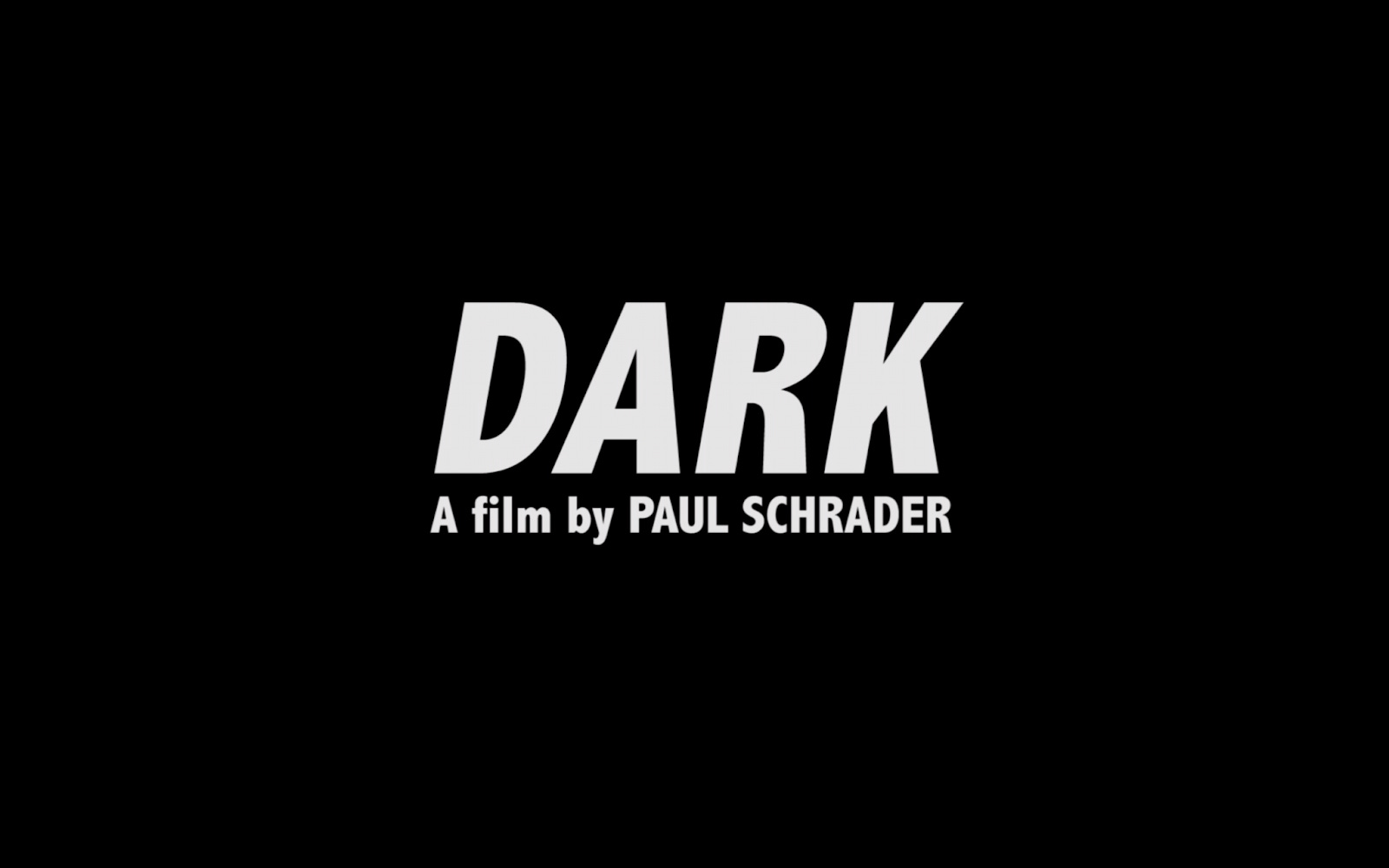
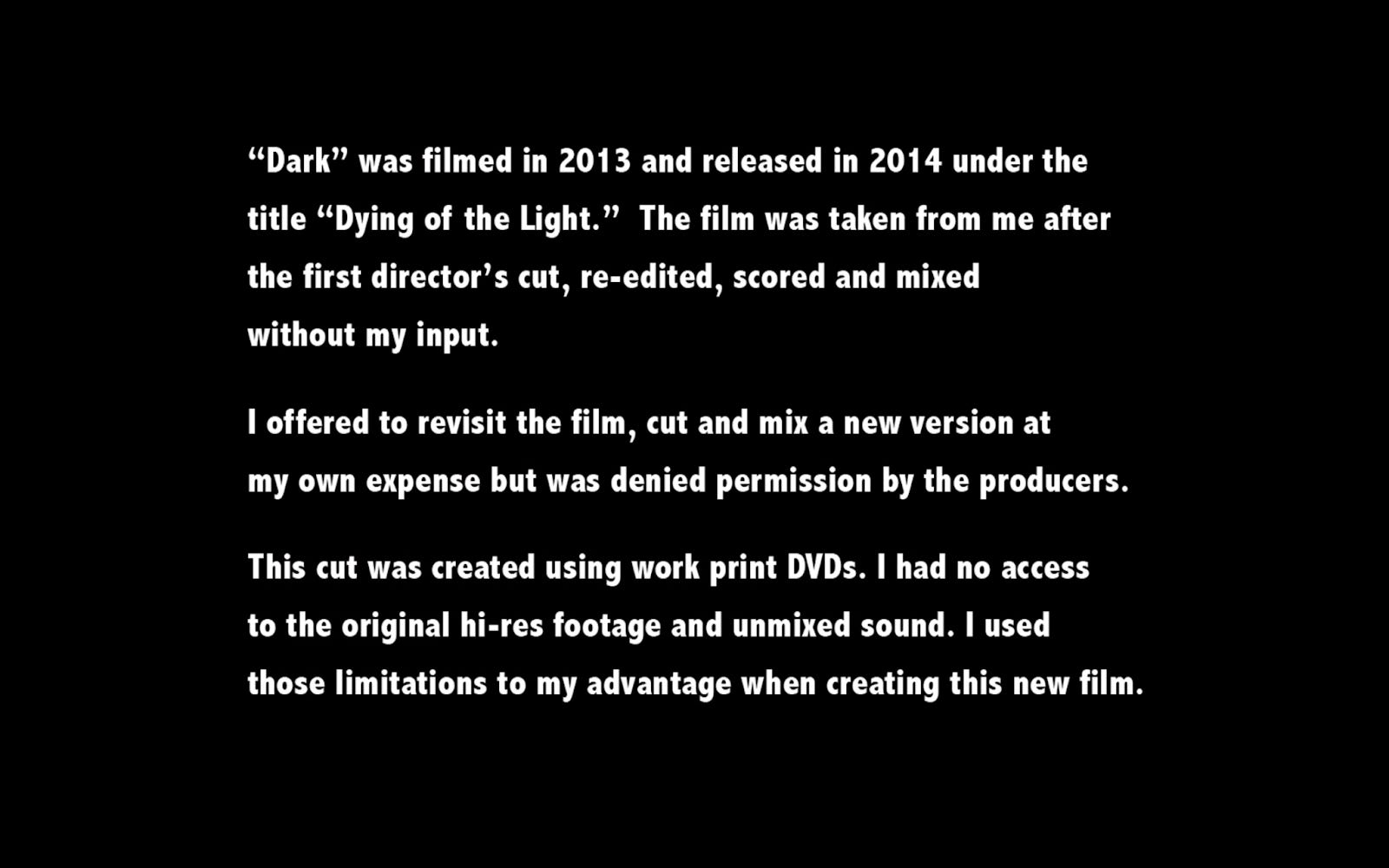
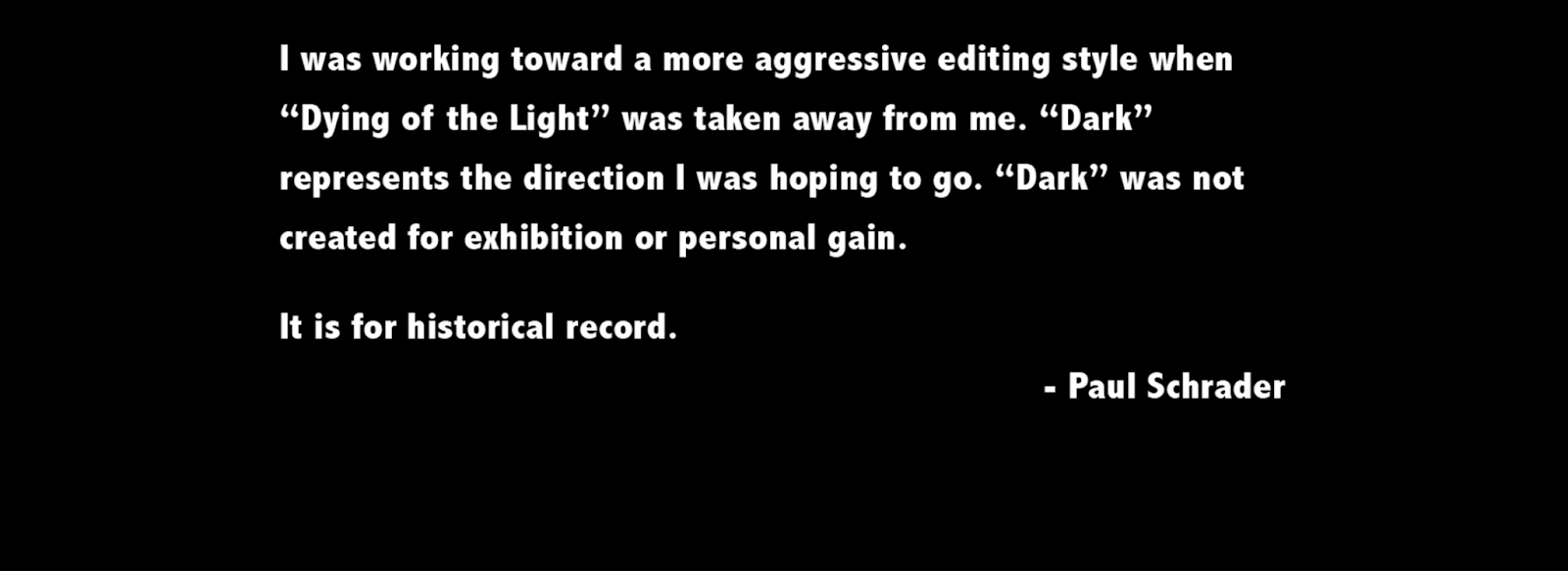
The opening title crawl of Paul Schrader’s reconstruction, Dark (2018).
In keeping with the initial disclaimer, Dark is much the same footage as Dying of the Light but with added digital treatment, a completely different dark-ambient synth score and more stylized, subjective editing clearly meant to emulate protagonist Evan Lake’s (Nicholas Cage) mental decline. Additionally, there are brief omnisciently narrated passages explaining Evan’s frontotemporal damage and looming dementia (“Although our protagonist does not know it yet, his brain is dying”) and the antagonist’s rare blood disease as well as a far more abrupt ending that excises the earlier incarnation’s final 15 minutes. Perhaps most radically, Schrader released Dark on the Swedish peer-to-peer torrent website The Pirate Bay (though it has since been archived officially, donated as part of the Paul Schrader collection housed by the Harry Ransom Center at UT Austin, and unofficially, on The Internet Archive).
It becomes clear that these films’ studio interference and resulting disparate cuts are a shared side effect of their creators’ turbulent careers – a manifestation of their plummeted social capital and resulting stints in the amorphous purgatory known as movie jail. Dying of the Light arrived at the tail end of the most troubled and transitory stretch of Schrader’s career, which arguably began when Affliction (1997) barely broke even at the box-office and ended when First Reformed (2017) was a surprise success. Having ended up in low-security movie jail numerous times throughout his career, and threatened with it even more times (though more often than not slapped on the wrist, placed on probation or sentenced to community service), Schrader took the momentum provided by First Reformed, his first hit in any capacity for 20 years, and ran with it. He has since adopted a production model defined by its austerity: barebones crew, month-long shoots and usually just one traditional movie star to pay. If he does his job well, the films easily make their money back [First Reformed, The Card Counter (2021)], and if they do not, they never seem to cost enough to bother the studio too much or discourage another equally modest distributor from offering their services the next time [Master Gardener (2023), Oh, Canada (2024)]. This austerity is a key tenet of Schrader’s and other similarly aged filmmakers’ sustained late-career success, should they enjoy any success at all given the current state of the filmmaking industry – the willingness to travel to the money, no matter the distant country from whence it comes (Abel Ferrara, Woody Allen); to accept the budget no matter how meager (William Friedkin, Walter Hill, Schrader); or any combination of the two (Brian De Palma, Roman Polanski).
There is an argument to be made for the preservation of each version, and perhaps all versions, entirely depending on how an archivist or historian hopes to define its significance and prescribe its use. Giovanna Fossati outlines four such frameworks for contemporary archival practice in From Grain to Pixel: “film as original,” “film as art,” “film as dispositif” and “film as state of the art.” In keeping with her preoccupation with film’s technological provenance and subsequent mediation, many of these distinctions boil down to specifications of form and original or ideal viewing experience. [The concept of dispositif, exemplified in Fossati’s volume by Nicholas Ray’s We Can’t Go Home Again (1973), was developed by Jean-Louis Baudry in the 1970s as a new framework for analyzing the cinematic experience apart from semiotics and psychoanalysis.] In many cases, the artist- and audience-preferred version of a text is not the original (that is, decidedly not part of the cultural heritage that many archivists revere and fetishize above all else), but an alternate version more closely aligned with Fossati’s “film as art” classification (itself the basis for some film archives). In situations such as these, the original release is more valuable as a document of historical importance than any traditionally accepted idea of a work of artistic expression.
The very concept of “film as original” is increasingly muddled by its confused nomenclature and unspecified materiality. As film (if it can even continue to be called as such) continues its inevitable migration from analog to digital – from the corporeal to the conceptual – what, exactly, is its original form? With its VOD origin (by its very definition, unreleased in theaters), can Dying of the Light claim any more authenticity or aura than the torrent-file-originated Dark? Even Cherchi Usai’s visceral intervention that cinema destroys itself with each successive use or viewing (“Cinema is the art of destroying moving images”), while true of a film print subject to physical wear and tear and degradation, is less applicable to content designed by and for use on computers, replaced by new, hitherto unknown hazards all their own. In this way, film’s form has become as malleable as its function. The medium is the message, or, as Ridley Scott somewhat mysteriously said of Blade Runner’s many cuts, “Sometimes the design is the statement.”
Baudry begins “The Apparatus: Metapsychological Approaches to the Impression of Reality in the Cinema” (first published in 1975 and translated into English in 1986) with a meditation on Plato’s “The Allegory of the Cave” (c. 375 BC) that seems especially prescient of this contemporary cut conundrum. “One constantly returns to the scene of the cave: real effect or impression of reality. Copy, simulacrum, and even simulacrum of simulacrum. Impression of the real, more-than-the-real?” Is any film really finished, or more real than another? To quote another infamous philosopher, it depends upon what the meaning of the word “is” is.